Lower Blepharoplasty in Berlin at Dottore Caletti
Compared to other body regions, the skin around the eyes is particularly thin and sensitive. Environmental influences and the natural aging process often become noticeable early on in the eye area.
Eye wrinkles, droopy eyelids, or eye bags can significantly alter a person's appearance. Eyelid corrections are therefore among the most frequently performed operations in plastic-aesthetic surgery. Depending on where the skin changes are noticeable, an upper or lower blepharoplasty can be performed.
Dottore Caletti offers such a lower blepharoplasty in Berlin and will be happy to advise you on all your questions.
- Duration of the procedure
- Approximately two hours
- Anesthesia
- General anesthesia
- Clinic stay
- Outpatient
- Socially presentable
- After two weeks
- Fit for work
- After two weeks, for jobs with heavier physical strain after three to four weeks
- Sports
- After four weeks
- Wound healing
- two weeks
- Costs
- Depending on the extent of the procedure and the surgical method, from 3,000 Euros
- Aftercare
- In the first few days after the procedure, cool the eye area, keep the head slightly elevated, avoid physical exertion, and do not use creams or make-up around the eyes. Stitches are removed after about one week
Before the actual procedure, the incision lines for the operation are drawn on your lower eyelids with a skin pen. You will then receive general anesthesia. The lower eyelid lift itself is performed gently and carefully with a scalpel. The removal of excess and sagging tissue and the tightening of the remaining skin requires precise plastic surgical work. The surgical incisions are then sutured. The procedure is completed after about two hours. The stitches are removed after approximately one week.
A lower eyelid lift is a low-risk procedure. If performed by an experienced specialist in plastic and aesthetic surgery, no complications are to be expected either during or after the operation. However, as with any other operation, risks cannot be completely ruled out with a lower eyelid lift. As a result of the procedure, for example, wound healing disorders, infections, scarring, and bleeding can occur. To minimize such risks, we recommend refraining from taking sleeping pills, pain medication, and blood thinners for at least one week before surgical removal of eye bags. It is optimal if you neither smoke nor consume alcohol during this time and in the first few weeks after the procedure, or reduce the consumption of these stimulants to a minimum. In the first few days after the operation, slight post-operative bleeding, tearing, dry eyes, or abnormal sensations in the eye region may occur. Your eyelids may initially not close completely. These symptoms are normal after a lower eyelid lift and no cause for concern. In case of more severe discomfort or pain, I am of course available at any time for an examination and treatment appointment.
Immediately after a lower eyelid lift, swelling and slight bruising are unavoidable - however, they usually subside within a few days. You can alleviate associated discomfort by continuous cooling. For this purpose, you can use soft cooling elements, a migraine mask, or special cooling compresses, which, however, should never come directly from the freezer. Excessive cooling can lead to post-operative bleeding at the operated sites. Rest and physical rest are also important in the first few days after the procedure. As a rule, you will no longer feel any pain immediately after the procedure. For safety, however, we will prescribe you a pain medication that you can take if you experience discomfort. For dry eyes, you will receive conjunctival moisturizing drops or an eye ointment. Your eyes should not come into contact with water for at least three days after the operation. In the first week, no massages, healing ointments for scar care, or make-up should be used to avoid wound healing disorders and unwanted permanent pigmentation. Your eyes will be more sensitive than usual for a longer period. In the first week after the eyelid lift, you should not watch television and also completely refrain from computer activities. Outdoors, you should wear sunglasses for one to two months. The complete wound healing process can take up to six months. Scars that are initially clearly visible and usually strongly reddened almost completely disappear during this time.
Facts and Information about Lower Eyelid Lift
The lower eyelid lift in Berlin is a surgical procedure in which excess skin and fatty tissue under the eyes - and sometimes also the eye bags - are removed and the skin undergoes sustainable tightening.
What is a lower eyelid lift?
A lower eyelid lift – in medical terminology, a blepharoplasty of the lower eyelid – is performed to remove excess skin and eye bags below the eyes. Sagging lower eyelids and bulges under the eye are thereby sustainably smoothed, so that the eye region appears fresher and regains a younger appearance.
How do eye bags develop?
Contrary to what many people assume, eye bags are not accumulations of tear fluid on the lower eyelid. Their cause is that the connective tissue under the eyes sags. Reasons for eye bags, in addition to skin aging, include lack of sleep, stress, and a genetic predisposition.
To understand how eye bags develop, some knowledge of the anatomy of the eyes and eyelids is helpful.
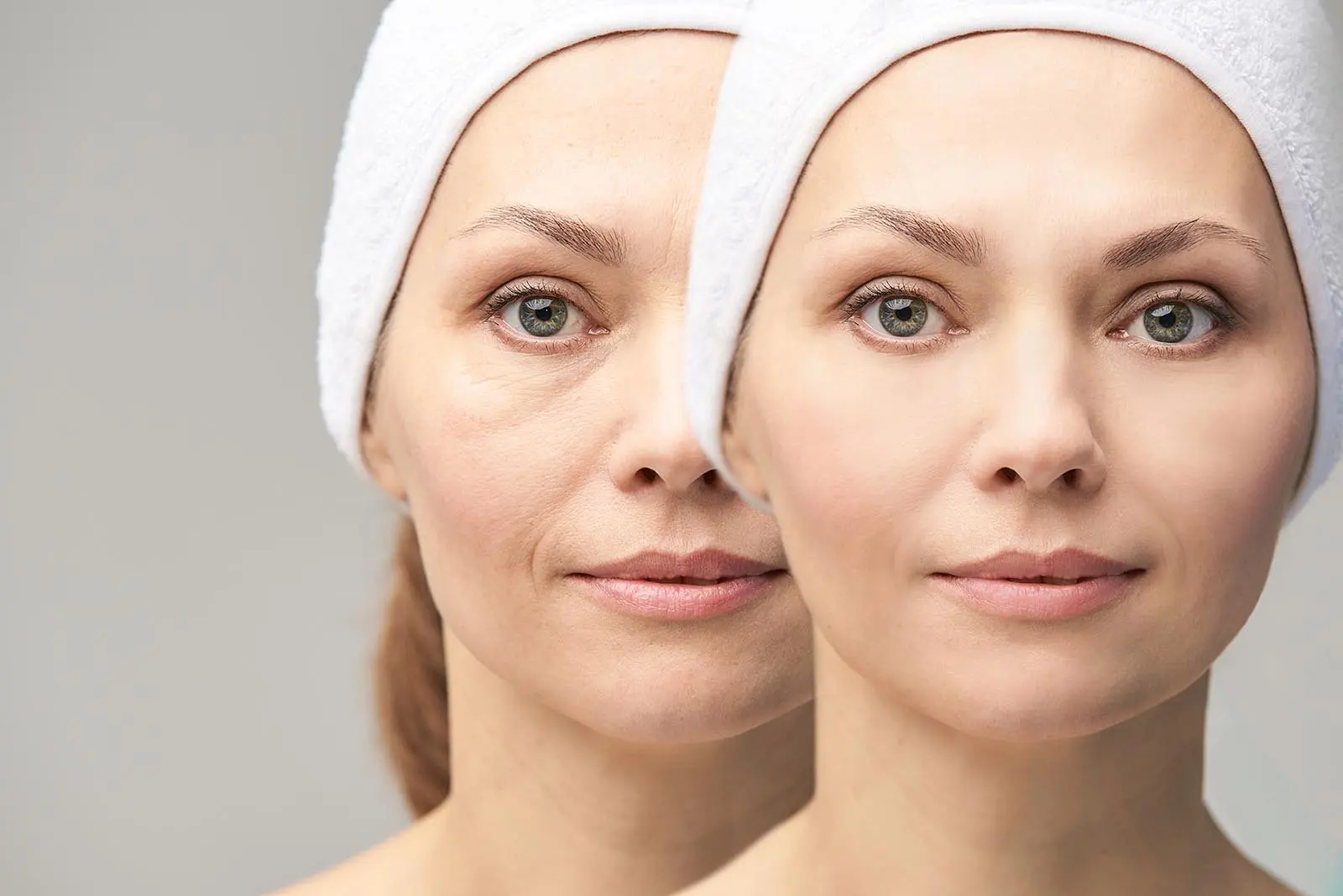
Background Knowledge: The Anatomy of the Eye Region
The lower eyelid consists of several tissue layers. The uppermost, visible layer is the skin. At its upper border, directly beneath the eye, runs the lash line. Beneath the skin lies the orbicularis oculi muscle, which allows us to close or open our eyes.
Behind the orbicularis oculi muscle are the fatty pads of the lower eyelid, covered by a thin layer of connective tissue. This tissue layer also contains the tarsal plate, which gives the lower eyelid its shape and firmness.
Slight fatty pads under the eyes are therefore a completely natural occurrence. Eye bags only form when the fat deposits exceed a certain extent and the skin and connective tissue bulge outwards. The innermost tissue layer in the lower eyelid is the conjunctiva. This is a mucous membrane that ensures the eyelids glide smoothly over the eyeball.
The bony boundary of the eye socket marks the border between the lower eyelid and the cheeks. Due to environmental influences and the natural aging process, the subcutaneous tissue becomes very thin over time, so that dark circles under the eyes can form, which are often also perceived as a cosmetic problem.
Utmost Caution with Lower Eyelid Surgery
When opening and closing the eyelids, the upper lid is actively mobile - the lower lid fulfills a stabilizing function by building up counter-pressure from below via the orbicularis oculi muscle. To achieve an optimal result in lower eyelid surgery and avoid complications, it is therefore important, among other things, not to injure this muscle and the nerves running through it. This is a key reason why eyelid correction should only be performed by an experienced doctor who keeps the entire anatomy of the eye region in mind during the procedure.
When the skin and connective tissue under the eyes lose their elasticity, the lower eyelid sags further and further downwards. At the same time, fatty tissue accumulates under the eyes to an increased extent, leading to the formation of eye bags. This further overstretches the skin, making it appear more wrinkled and saggy.
Eye bags are almost always a purely cosmetic problem - they only indicate a disease in the rarest of cases. A medical cause for eye bags is, for example, an eyelid malposition. Lower eyelid surgery permanently removes eye bags. Eyelid malpositions are also corrected by this.
When is Lower Eyelid Surgery Useful?
Lower eyelid surgery is useful when sagging lower eyelids and eye bags lead to a change in the overall facial expression. Due to the weakness of the connective tissue and the fat deposits, the eyes appear smaller and swollen. Wrinkles under the eyes also become more visible. The face looks tired, pessimistic, and often years older. This is also contributed to by the fact that the orbicularis oculi muscle around the eye relaxes over time. If these changes affect your aesthetic body image and quality of life, you should opt for lower eyelid correction.
If you visit my Berlin practice for lower eyelid surgery, I will provide you with comprehensive advice before the procedure and together with you decide whether lower eyelid correction is useful and how I will best proceed.
What Results Can Be Achieved with Lower Eyelid Surgery?
Lower eyelid surgery not only makes eye bags disappear but also wrinkles under the eye. During the approximately two-hour operation, the doctor removes excess skin, slack tissue, and fat deposits on the lower eyelid. The remaining skin is tightened, so that eye wrinkles are significantly reduced or completely removed. If necessary, not only the lower eye area is treated, but also an upper eyelid lift is performed.
Since the incision for the procedure is made below the lash line, it is barely visible after the healing process is complete. After lower eyelid surgery, not only your eyes but your entire face will look younger and fresher. The extent of the procedure depends on the individual findings of your eyelids and the severity of the eye bags. The final result will be visible after a few weeks and then lasts on average for over 10 years.
Combination with Other Treatments
Lower eyelid surgery can be well combined with other treatment methods to achieve an aesthetically optimal result. These include, for example, the injection of wrinkles and dark circles or a modeling of facial contours through injections with fillers such as hyaluronic acid or autologous fat, so that the face as a whole appears rejuvenated and fresher.
Since lower eyelid laxity often does not occur in isolation, but the upper eyelid also changes and has lost elasticity, an upper eyelid lift is often advisable in many cases, together with lower eyelid correction, for an optimal result.
Advantages of Lower Eyelid Surgery
The advantages of lower eyelid surgery consist of a more open gaze and more radiant eyes. The skin and connective tissue under the eyes regain elasticity, and eye bags are completely eliminated. Even if only the region under the eyes is treated, the face appears significantly younger and firmer. Wrinkles in the lower eye region are less visible.
Which Methods Can Be Used for Lower Eyelid Surgery?
There are two basic options for performing lower eyelid surgery - transcutaneous and transconjunctival lower eyelid correction. Which procedure is used depends on the individual circumstances of the patient. If larger skin excesses are to be removed for effective tightening of the lower eyelid, the transconjunctival method cannot be used.
If you decide to have lower eyelid surgery in Berlin, I will inform you about both correction options and explain why I have chosen the respective method.

Transcutaneous Lower Eyelid Surgery
During a transcutaneous lower eyelid lift, an incision is made in the skin just below the lash line. Excess skin and fatty tissue are then removed. If modeling and stronger contouring are desired in the lower eyelid area or other facial areas, the removed fat pads can also be used for a so-called lipofilling (autologous fat transplantation). The incision later forms a fine scar, which, however, is barely visible after the healing process is complete.
Transconjunctival Lower Eyelid Lift
In a transconjunctival lower eyelid lift, the incision for removing eye bags is made through the conjunctiva on the inside of the lower eyelid - "conjunctiva" is the medical term for the conjunctiva of the eye. With this incision technique, no scars are visible.
Removing Eye Bags
In addition to the incision technique, several other criteria play a role in the techniques used for a lower eyelid lift, which depend on the individual findings of the patient.
The following describes some examples that combine lower eyelid lift techniques with plastic-surgical treatment of other cosmetic problems. A lower eyelid lift can remove eye bags and combine this treatment with the removal of dark circles. Under the eyes there is a connective tissue plate, whose function is to fix the fatty tissue in the eye socket.
When it sags, eye bags and - as the connective tissue sinks downwards - often dark circles appear. The lower eyelid lift technique shifts the fatty tissue upwards so that it can act as a filler that makes dark circles disappear. At the same time, the lower eyelid is modeled and regains a smooth and even contour. A lower eyelid lift can be combined with lipofilling. This allows dark circles and the entire face to be plumped up with the body's own fat, bringing new freshness to the face.
Correction of Muscle Tension and Skin Removal
A lower eyelid lift is performed by tightening the orbicularis oculi muscle and removing excess skin. For the choice of the correct surgical technique, the doctor must weigh whether the focus in the individual case is on the correction of muscle tension or the removal of excess skin. With increasing age, the decreasing muscle tension particularly affects the condition of the lower eyelids, so that excess skin is only carefully removed.
Tightening of the Eyelid Ligaments
If the eyelids are very loose and overstretched, the lower eyelid no longer rests correctly on the eyeball. This change is particularly typical for older age. To correct this, it is not enough to tighten the orbicularis oculi muscle. Instead, a tightening and refixation of the suspensory apparatus of the lower eyelids must be carried out.
How is a lower eyelid lift performed in Berlin at Dottore Caletti?
For the preparation and successful execution of a lower eyelid lift, the physical examination as part of a detailed consultation with your doctor plays an essential role. The procedure itself consists of the following components:
- Tightening of the area under the eyes
- Reduction of excess skin, removal of fatty tissue
- Stabilization and tightening of the orbicularis oculi muscle to give the tissue under the eye better support again.
Preparation and thorough examination for the lower eyelid lift in Berlin
To prepare for the lower eyelid lift, the doctor analyzes all parameters of the anatomy and function of your lower eyelids. The result of this examination determines which techniques will be used for the procedure and how the incision will be made below the eyelashes.
An important part of the examination is the determination of the muscle tension of the orbicularis oculi muscle to assess the stability of the lower eyelid. If errors occur here, for example, a so-called deep-set eye or drooping eyelid can develop after the operation, for the regression of which a longer post-treatment would be necessary.
To avoid this complication, special stabilizing techniques must be used for eyelid lifts in very loose lower eyelids. The trend in lower eyelid lifts has been for several years to combine tightening and stabilization of the eyelid from the outset. In addition, possible misalignments of the eyelids are detected during the preliminary examination in order to adapt the techniques of the procedure, if necessary, to these as well.
On the day of the surgery
Immediately before the eyelid lift, the incision for the operation is drawn on the lower eyelids with a skin pen. Theoretically, an eyelid lift can also be performed under local anesthesia with light twilight sleep. However, due to the duration of the operation, general anesthesia is administered.
The lower eyelid lift and the removal of eye bags are performed gently and carefully with a scalpel and partly also with a high-frequency probe. The removal of excess tissue and the tightening of the remaining skin requires plastic-surgical precision work.
Subsequently, the surgical incisions are sutured. A lower eyelid lift is completed in about two hours. You can return to work and social activities after about 14 days. The stitches are removed after one week. At this point, the surgical incisions are already healed and the incisions are often barely visible.
Immediately after the surgery
After the lower eyelid surgery, you will remain in my practice in Berlin for one to two hours for observation. You should rest for at least the first three days. Rest and physical recuperation are important for a few days. Sports and physically demanding activities are possible again after about three weeks.
As a rule, you will no longer feel any pain immediately after the operation. However, to be safe, we will prescribe a pain medication that you can use if you experience discomfort. For dry eyes, you will receive conjunctival moisturizing drops or an eye ointment.
In case of more severe discomfort, which is rare after a lower eyelid surgery, anti-inflammatory drugs and elevating your head and upper body can provide relief.
The days and weeks after
Your eyes should not come into contact with water for at least three days after the operation. In the first week, no massages, healing ointments for scar care, or make-up should be used to avoid wound healing disorders and unwanted permanent pigmentation.
Your eyes will remain more sensitive than usual for a longer period. It can take up to six months for the wound healing process to be completely finished. Initially visible scars will almost completely disappear during this time.
Risks of lower eyelid surgery
Lower eyelid surgery is a low-risk procedure. If performed by an experienced specialist in plastic and aesthetic surgery, no complications are to be expected either during or after the operation.
However, as with any other operation, complications and risks cannot be completely ruled out with lower eyelid surgery. As a result of the procedure, for example, wound healing disorders, infections, or medication intolerances can occur.
To minimize such risks, I recommend that you refrain from taking sleeping pills, pain medications, and blood thinners for at least one week before a surgical lower eyelid surgery during the consultation. It is optimal if you neither smoke nor consume alcohol during this time and two to three weeks after the lower eyelid surgery, or reduce the consumption of these stimulants to a minimum.
Immediately after the operation, slight post-operative bleeding, tearing, dry eyes, or abnormal sensations in the eye region may occur. Your eyelids may not be able to close completely at first. These symptoms are normal after a lower eyelid surgery and no cause for concern.
Lower eyelid surgery in Berlin - detailed consultation and individual therapy at Dottore Caletti
If you are interested in a lower eyelid surgery in my specialist practice for plastic and aesthetic surgery in Berlin, we will first arrange an appointment for a detailed consultation. At this appointment, I will get to know your wishes and your personal circumstances. I will explain the procedure of a lower eyelid surgery as well as possible complications and risks of the procedure.
Frequently asked questions
Lower eyelid surgery takes at least two hours. In the case of a very extensive surgical area or in combination with other plastic-surgical treatments, lower eyelid surgery can take even more time in individual cases. As a plastic-aesthetic surgeon, I perform delicate work on your eyes during the operation. For this reason, general anesthesia is less stressful for you - and for me - during a lower eyelid surgery than local anesthesia with twilight sleep.
If you generally do not wish for general anesthesia, please discuss this with me during the consultation. In principle, lower eyelid surgery is also possible under local anesthesia. By administering a light sedative, you will then experience the operation in twilight sleep.
The result of a lower eyelid surgery lasts about 10 to 15 years. Due to natural skin aging, a repeat of the procedure may be necessary afterwards. No new scars will form, as the incisions are made over the already existing, very fine scars.
If the lower eyelid lift is performed by an experienced specialist in plastic and aesthetic surgery, no unnatural changes in facial expressions are to be feared.
Although the procedure influences the expression and thus also the facial expressions - but in a positive sense: The individual facial expressions are not changed or designed, but emphasized. A lower eyelid lift allows them to come into their own again without restrictions. Personally, it is fundamentally important to me with every treatment that the result looks absolutely natural and emphasizes your individual radiance.
An eyelid lift should generally only be performed by an experienced specialist in plastic and aesthetic surgery - the need for a subsequent correction is then as good as excluded. In addition, the complete surgical result is only visible after three months or - in individual cases even at a somewhat later point in time. However, already a few days or weeks after the lower eyelid lift, you will see that your eye area and also your overall appearance have changed positively.
Basically yes. In some cases, such a combination is even recommended in the interest of an overall aesthetic concept. During the consultation in my practice, we clarify what you wish for in this regard and whether such a direct combination makes sense from a medical and aesthetic perspective. Together with eyelid tightening (including upper eyelid lift), I offer in my specialist practice for plastic and aesthetic surgery, for example, the correction of dark circles, wrinkle treatments and facial modeling with hyaluronic acid or lipofilling (autologous fat) as well as Nanofat treatments. These procedures can be performed simultaneously without problems.
If you follow my recommendations for aftercare, you support the healing process and prevent the formation of permanent scars. Important in the first few days after the procedure are physical rest and regular cooling. You prevent wound healing disorders and pigment deposits - the so-called scar tattooing - by refraining from creams and make-up in the first week after the procedure.
Hyaluronic acid is a natural active ingredient that is also produced by the body itself. Over time, however, it is produced in ever smaller quantities. Hyaluronic acid primarily helps to regulate the moisture balance of body tissues, thereby tightening them and giving them elasticity. In plastic and aesthetic medicine, it is used as a filler to inject dark circles and wrinkles or to model individual facial regions.
For a lipofilling (autologous fat treatment), fat cells are removed from another part of the body, prepared accordingly and then injected into the facial area to be treated. Such an autologous fat treatment is suitable, for example, for wrinkle injection or lip modeling. Lipofilling is one of my specialties as a plastic and aesthetic surgeon - I have already dealt intensively with this topic and its applications during my studies and later also in my practice in the clinic.
Nanofat is an innovative technique in plastic and aesthetic surgery - the focus is not on facial modeling, but on sustainable skin rejuvenation. Only the stem cells and growth factors as regenerative components of the fatty tissue are transferred. They are injected with the finest cannulas into the uppermost skin layer. Nanofat promotes cell renewal very effectively. It is used for aging or impure skin, against dark circles, for the correction of other unwanted pigmentations as well as in scar therapy.
If you follow my recommendations for aftercare, you support the healing process and prevent the formation of permanent scars. Important immediately after the operation are physical rest, regular cooling, and refraining from sports for at least three weeks. You prevent wound healing disorders and pigment deposits - the so-called scar tattooing - by refraining from creams and make-up in the first week after the procedure.
It is most important that you follow my advice on surgical preparation. This includes refraining from pain medication, sleeping pills, and blood thinners for at least one week before the procedure, and ideally also avoiding nicotine and alcohol.
In the first week after the procedure, your eyes are so sensitive that wearing contact lenses is not possible. In addition, inserting and removing the lenses would irritate the skin in the surgical area - this can result in disturbances of the healing process. Therefore, I would like to ask you to refrain from wearing contact lenses until the stitches are removed. At this appointment, we will discuss whether you can wear your contact lenses immediately afterwards or should wait a few more days.
An eyelid lift is suitable for all patients who feel their aesthetic self-image is impaired by skin and tissue changes under the eyes. It can be performed as an upper or lower eyelid lift or as a combination of both.
Eyelid correction is considered a very low-pain procedure. Many of my patients report that they were completely pain-free on the day of the operation. You may experience slight wound pain in the first few days - we will provide you with painkillers and anti-inflammatory drugs that you can use if necessary.
Eyelid surgery is a straightforward, outpatient procedure – an inpatient stay in the clinic is not necessary or intended. After the operation, my patients rest for one to two hours in the clinic connected to our practice and can then go home. Important: Due to general anesthesia, you should not drive a car yourself on the day of the operation.
Certain diseases – for example, severe high blood pressure, poorly controlled diabetes mellitus, and some autoimmune diseases – can contraindicate eyelid surgery. The same applies to treatment with blood-thinning medications if they cannot be discontinued. In such cases, the procedure must be postponed. During the consultation, we clarify whether there are reasons that contraindicate lower eyelid surgery at the planned time.
Cost coverage by health insurance is almost always excluded, as lower eyelid surgery is considered a purely cosmetic procedure. Exceptions exist if the eyelid sagging is necessary for medical reasons, such as eyelid malpositions.
For this, you need to know that the professional title of cosmetic surgeon is not protected in Germany. Whether a doctor has actually completed several years of theoretical and practical training in this field can be seen from the titles "Doctor for Plastic-Aesthetic Operations" or "Specialist in Plastic and Aesthetic Surgery." Important indications of your doctor's qualifications are also their practical experience with eyelid corrections – therefore, you should not hesitate to ask about this during the preliminary consultation. I personally specialized increasingly in plastic and aesthetic surgery during my studies and continuously deepened this knowledge during my specialist training and in my clinical work.

Do you have questions about lower eyelid surgery?
If you still have any questions, we will be happy to discuss them personally and without obligation in our Berlin practice.