
Lower eyelid lift in Berlin: options and procedure
A lower eyelid lift in Berlin may be considered for excess skin or persistent bulging tissue beneath the eyes.
Dark circles and fluctuating swelling need a separate assessment.
During my consultation on Kurfürstendamm, I examine your lower eyelids and discuss with you whether surgery is appropriate for your clinical findings and wishes.
- Duration of the procedure
- Around two hours, depending on the planned extent
- Anaesthesia
- Local anaesthesia, with sedation if appropriate, or general anaesthesia
- Clinic stay
- Monitoring and further care according to an individual treatment plan
- Return to social activities
- Approximately 14 days as a guide; visible signs may persist for longer
- Return to work
- Approximately 14 days as a guide; physically demanding work may require a longer period of rest
- Exercise
- Often after about three weeks, depending on follow-up findings and aftercare
- Wound healing
- Healing and scar maturation over several months, potentially up to six months
- Costs
- Determined individually according to the extent of surgery, anaesthesia and aftercare; total costs following examination and treatment planning
- Aftercare
- Plenty of rest, especially during the first three days. No make-up, massages or self-applied scar ointments during the first week. With an external approach, stitches are often removed after about a week; further measures depend on follow-up findings.
Lower eyelid correction follows the treatment plan discussed beforehand. If an external incision is used, its course is marked on the skin before surgery. In principle, local anaesthesia, with sedation if appropriate, or general anaesthesia are options. Skin removal, treatment of fatty tissue and stabilisation are possible components, but are not mandatory steps for everyone. Lower eyelid surgery can take around two hours. With an external approach, the surgical incisions are then sutured. The procedure is followed by a monitoring period tailored to the surgery and anaesthesia.
We explain the possible complications below in the section “Risks and symptoms that need assessment”. The following is particularly important for the period after your surgery:
Severe or increasing pain, sudden pronounced swelling or visual disturbances require immediate medical attention. Contact your treating team immediately. If they cannot be reached immediately, seek emergency eye care or go to an emergency department without delay. If you experience visual disturbances, go there directly. If these warning signs occur, do not wait for a follow-up appointment or a reply to your message.
Plan for plenty of rest, especially during the first three days. Approximately 14 days is a guide for work and social engagements; visible signs and physically demanding work may require a longer break. Swelling, bruising and a feeling of tightness may occur.
We explain how to care for the area and tailor stitch removal and your return to exercise to your healing progress. You will find details further below under “Recovery and aftercare in everyday life” and “The days and weeks afterwards”.
What a lower eyelid lift in Berlin can treat
A lower eyelid lift is a surgical correction of the lower eyelids. It can reduce excess skin and treat protruding fatty tissue so that the transition between the lower eyelid and the cheek appears more even. The aim may be a more rested expression – without fundamentally changing your eye area.
What is a lower eyelid lift?
Blepharoplasty is the medical term for surgical correction of eyelid skin and, where appropriate, underlying tissue. It can involve the upper eyelids, the lower eyelids or both areas. Which tissues are removed, redistributed or stabilised depends on the findings.
What causes bags under the eyes?
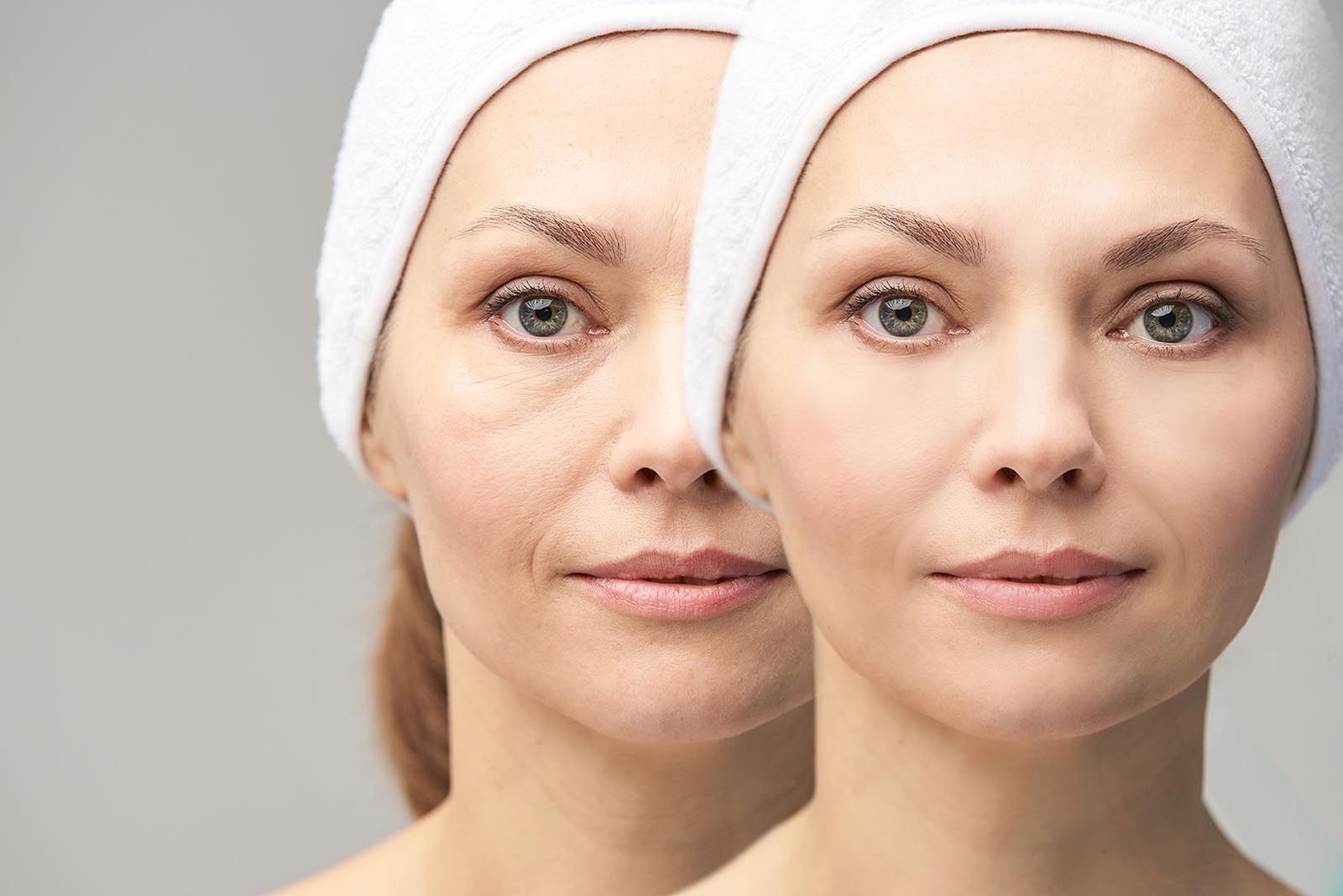
In everyday language, bags under the eyes refers to visible bulges beneath the eyes. In the case of persistent bulges, fatty tissue may protrude from behind lax supporting structures; this is not an accumulation of tear fluid. You can learn more about the general distinctions under Removing bags under the eyes.
Fluctuating swelling must be distinguished from this and does not automatically lead to a recommendation for surgery.
Why lower eyelid stability matters
The lower eyelid consists of several layers of tissue. The outermost, visible layer is the skin. The lash line runs along its upper edge, directly below the eye. Beneath it lies the orbicularis oculi muscle: it closes the eyelids; other muscles are responsible for lifting the upper eyelid.
Behind the muscle lie further supporting structures and fat pads. A thin layer of connective tissue helps to retain the fatty tissue within the eye socket. If this boundary becomes lax, existing fat can protrude forwards; a bulge therefore does not necessarily mean that additional fat has accumulated.
Small fat pads beneath the eyes are a natural feature; visible bulges are commonly referred to as bags under the eyes. The innermost tissue layer of the lower eyelid is the conjunctiva. This is a mucous membrane that allows the eyelids to glide over the eyeball without friction. The firm tissue components of the lower eyelid and its lateral supporting structures are also important for its position.
Dark circles under the eyes are a different finding. Shadows caused by hollows may change with suitable contour correction; however, lower eyelid correction does not automatically lighten or firm dark or very thin skin. Fine smile lines may also remain.
Taking eyelid function into account in lower eyelid correction
Lower eyelid correction is not just about removing skin. The eyelid should continue to sit properly against the eye and support eyelid closure. I assess how stable it is and whether additional tightening or fixation of its supporting structures might be appropriate.
An existing malposition or incomplete eyelid closure affects which correction is reasonable and appropriate. Symptoms may need further assessment first.
When is a lower eyelid lift appropriate?
Perhaps you would like less bulging, or perhaps excess skin bothers you most. I first want to understand which change matters to you. Wrinkles under the eyes also need their own assessment; fine smile lines may remain. Surgery is a personal decision, not a necessary response to ageing.
During my consultation on Kurfürstendamm, I examine your lower eyelids and discuss with you whether surgery is suitable for your findings and wishes.
What result can be achieved with a lower eyelid lift?
A lower eyelid lift can correct excess skin and protruding fat pads. The aim is a more even contour beneath the eyes and a more rested expression. This does not automatically eliminate dark circles under the eyes. You can find information about changes to the upper eyelids under Upper eyelid lifting.
An external approach leaves a scar that is often fine and inconspicuous; complete invisibility cannot be promised. The surgical result should only be assessed after sufficient healing.
Weighing up combinations together
A lower eyelid lift in Berlin is not automatically supplemented by other treatments. Whether a combination is appropriate depends on whether there is a separate treatable finding in addition to the lower eyelid. Hollows under the eyes and expression lines also need their own assessment. Filler injections are not an automatic addition to surgery.
An upper eyelid lift treats excess skin on the upper eyelids and, where appropriate, underlying tissue. It may be considered together with lower eyelid correction if the findings warrant it, but it does not replace an examination of the function of each eyelid.
Understanding treatment areas and costs
Hooded eyelids is the everyday term for a fold of skin that partially covers the mobile upper eyelid. This is not the same as pathological drooping of the entire upper eyelid. The position of the eyebrows can also affect the appearance. The main page on eyelid lifting helps you understand the different treatment areas.
The costs depend on the planned extent of treatment, the anaesthesia and the aftercare. Before you make your decision, we explain the individual treatment plan and the expected total costs.
Which surgical approaches may be considered
There are two basic options for performing a lower eyelid lift: the transcutaneous approach through the outer skin and the transconjunctival approach through the conjunctiva. Excess skin, fat distribution and eyelid stability are the deciding factors. An externally inconspicuous approach is not sufficient reason to choose a procedure regardless of the findings.
The choice is guided by your anatomy, not by a generally preferred procedure. I explain which change each approach allows, what limitation remains and why additional stabilisation may be part of the procedure.

Comparing the two surgical approaches
| Transcutaneous: through the skin | Transconjunctival: through the conjunctiva | |
|---|---|---|
| Incision placement | Just below the lash line. | On the inside of the lower eyelid. |
| What correction is possible | Excess skin and, if necessary, deeper tissues can be treated. | May be considered when the main aim is to treat protruding fatty tissue and no substantial excess outer skin needs to be removed. |
| Excess skin | Excess skin can be removed through this approach. | Significant excess outer skin cannot be removed through this approach alone. |
| External scar | After healing, a scar remains that is often fine and inconspicuous. | This approach leaves no external skin incision scar. |
With both approaches, we assess eyelid position and lower eyelid stability. Additional stabilisation may be necessary depending on the findings.
Treating under-eye bags with surgery
If you would like to have under-eye bags treated with surgery, you should distinguish between fat removal and fat repositioning. Depending on the findings, some existing fat can be preserved and repositioned to shape the contour.
Not every procedure involves removing as much tissue as possible. Planning takes into account how bulges and hollows interact and how stable the lower eyelid is. The aim is a suitable contour, not the greatest possible removal of tissue.
Tightening the canthal tendons
If the eyelids are very loose and overstretched, the lower eyelid no longer rests correctly against the eyeball. Removing skin alone does not address this problem. Depending on the initial condition, stabilisation may need to take greater priority than tissue removal.
The course of your treatment
How we prepare for your lower eyelid correction
Before lower eyelid surgery in Berlin, I examine the position, mobility and stability of your lower eyelids. We assess excess skin and bulging fat as well as the transition to the cheek. In doing so, we distinguish your aesthetic wishes from symptoms that first require further investigation.
An important part of the examination is determining the muscle tone of the orbicularis oculi muscle to assess the stability of the lower eyelid. I also check whether eyelid malposition or incomplete eyelid closure is already present. These findings influence which correction is appropriate and reasonable.
Please tell me about dry eyes, previous operations and any previous treatments around the eyes. Known medical conditions, allergies and a tendency to bleed should also be discussed. If you have symptoms or relevant previous findings, an ophthalmological examination may be necessary, for example to assess tear production or vision. Bring a list of your medications, including painkillers and sleeping tablets taken occasionally. You must not stop taking blood-thinning medication on your own.
On the day of surgery
Lower eyelid surgery can take around two hours. The exact time required depends on the planned correction and any additional measures.
Reviewing the treatment plan together
Before the procedure, we discuss the planned correction and its limitations again. If an external incision is used, its course is marked on the skin.
The agreed anaesthesia
Local anaesthesia, with sedation if appropriate, or general anaesthesia may be considered. The choice depends on the extent of the procedure and your individual circumstances—not on what has suited other people. The duration alone does not make general anaesthesia essential.
Correction based on your findings
Depending on the treatment plan, we reduce excess skin and remove a limited amount of fatty tissue, reposition it or preserve it. If the findings require it, we also stabilise the lower eyelid. Not every procedure includes all components. Even if your main aim is to reduce under-eye bags, stabilisation may be important.
Suturing with the external approach
With the external approach, the surgical incisions are then sutured.
Monitoring after the procedure
The operation is followed by a period of monitoring. We tailor its duration and subsequent care to the procedure and the anaesthesia.
Recovery and aftercare in everyday life
Lower eyelid surgery and healing must be considered together when scheduling the procedure. You should plan for plenty of rest during the first three days. Around 14 days serves as a guide for work and social commitments, although visible signs may persist for longer and physically demanding work must be assessed differently from less strenuous work.
Swelling, bruising, tightness and pain can occur after lower eyelid surgery. We discuss suitable measures and, if needed, pain medication; you should not simply mask severe or worsening symptoms by taking additional tablets.
Dry eyes can occur after the procedure. Depending on your needs, you will receive lubricating eye drops or an eye ointment. If your eyes do not close completely, water more heavily or remain irritated, we need to carry out a check-up rather than simply adjust your care.
The days and weeks afterwards
You will receive specific instructions for cleaning the area around your eyes. During the first few days, water should not come into direct contact with the surgical sites; during the first week, avoid make-up, massage and scar ointments applied on your own initiative. When you can resume using skincare products depends on the condition of the wounds.
With the external approach, suture removal is often scheduled for about one week after surgery. This does not mean that the tissue can already withstand full strain. Sport and more strenuous physical activity can often only be considered again after about three weeks; the findings at your check-up and the agreed aftercare remain the deciding factors. Longer-term healing and scar maturation can extend over months, in some cases up to six months. An initially visible scar can become considerably less noticeable during this time.
Risks and symptoms that require investigation
Like any operation, lower eyelid surgery carries risks. These include postoperative bleeding, infections, impaired wound healing and intolerance to medication. Careful planning and aftercare are important, but do not rule out complications.
In particular, the lower eyelid margin may move downwards, the lower eyelid may pull away from the eye, or difficulties with complete eyelid closure may occur. Dryness, excessive tearing and altered sensations must also be assessed over time. Depending on the cause, prolonged follow-up treatment or further correction may be necessary.
You should have a lower eyelid that pulls away from the eye checked by a doctor promptly, even if it causes little pain at first. The fact that swelling can occur after surgery does not automatically make a change in eyelid position harmless. Please do not start massaging the eyelid yourself to push it back into place. We coordinate changes to your medication with your treating doctors; you must not stop taking blood thinners on your own.
Bleeding within the eye socket or severe infections can endanger vision.
Severe or increasing pain, sudden pronounced swelling or visual disturbances require immediate medical assessment. Contact the treating team immediately. If they cannot be reached straight away, seek emergency ophthalmic care or attend an emergency department without delay. If you experience visual disturbances, go there directly. If these warning signs occur, do not wait for your next check-up or a reply to a message. We discuss with you how to reach us after the procedure and where to turn in an emergency.
Your questions about lower eyelid surgery
I am Andrea Caletti, a specialist in Plastic, Reconstructive and Aesthetic Surgery and a specialist in Surgery. You can learn more about my professional background on my personal page. When making your decision, you should understand not only the incision placement and downtime, but also realistic changes and how follow-up appointments are organised. We take time for the decision; unanswered questions are expressly welcome as a reason for another consultation.
Frequently asked questions about lower eyelid surgery
When is an approach through the inside of the lower eyelid an option?
Transconjunctival lower eyelid surgery may be an option if the main aim is to treat bulging fatty tissue and no substantial excess external skin needs to be removed. The incision is made through the conjunctiva on the inside of the lower eyelid. Eyelid position and stability must also be examined with this approach. Significant excess external skin cannot be removed through this approach alone.
Is fat always removed during lower eyelid surgery?
Fat is not routinely removed during lower eyelid surgery. Depending on the findings, limited removal, redistribution or preservation of the existing fatty tissue may be appropriate.
Can lower eyelid surgery eliminate dark circles under the eyes?
Lower eyelid surgery does not automatically eliminate dark circles under the eyes. If shadows are caused by bulges or hollows, appropriate contour correction may change their appearance. However, the procedure does not automatically lighten dark skin pigmentation or firm very thin skin. This is why, before surgery, we examine what is actually causing the dark appearance under your eyes.
Why is the stability of my lower eyelids examined?
The stability of the lower eyelids affects how the eyelid rests against the eye and supports eyelid closure. Lower eyelid correction must therefore consider more than just visible excess skin. If the supporting structures are loose, additional stabilisation may be necessary. The examination helps tailor the procedure to your initial condition and take the risk of an unfavourable eyelid position into account.
Lower eyelid surgery and healing: How much recovery time should I plan for?
After lower eyelid surgery, around 14 days is a guide for returning to work and social engagements. Physically demanding work, exercise and persistent swelling may require a longer period of rest. External sutures are often removed after about a week. Complete healing and scar maturation take considerably longer and may extend over several months.
What does it mean if the lower eyelid pulls away from the eye after surgery?
A lower eyelid that pulls away from the eye after lower eyelid surgery may indicate a change in eyelid position and should be examined promptly by a doctor. Do not simply wait and do not start massaging it yourself.
Severe or increasing pain, sudden pronounced swelling or visual disturbances require immediate help. Contact the treating team immediately. If they cannot be reached immediately, seek emergency eye care or go to an emergency department without delay. If you experience visual disturbances, go there immediately.
Can the upper and lower eyelids be treated together?
Yes, if examination of both eyelid areas supports this. To help you plan, we discuss the extent of the combined correction, which type of anaesthesia may be suitable, and what recovery time and total costs to expect. A shared surgery appointment alone is not a reason for an additional correction.
What are the risks of lower eyelid surgery?
The risks concern wound healing, eyelid function and, in the event of severe complications, vision as well. Prolonged follow-up treatment or further correction may be necessary. We explain the individual risks and help for warning signs in the section “Risks and symptoms that require assessment”. We discuss your personal risks before you make your decision.
How much does lower eyelid surgery cost in Berlin?
The cost of lower eyelid surgery in Berlin depends on the individual extent of the surgery, the anaesthesia and the aftercare. Limited treatment of fat bulges requires different planning from a correction involving skin removal and additional stabilisation. After the examination, I explain the proposed treatment plan and the expected total costs before you make your decision.
How long do the results of lower eyelid surgery last?
Lower eyelid surgery can change the contour of the lower eye area over the longer term, but it does not stop the natural ageing process. How the result develops depends, among other things, on the initial findings and subsequent tissue changes. A fixed duration cannot be promised.